

Supplements for immunity: Evidence-based guide 2026
TL;DR:
- Supplements like vitamins D and zinc are mainly beneficial for correcting deficiencies, especially in older adults.
- A balanced, nutrient-rich diet remains the most effective foundation for immune health in healthy individuals.
- Excessive supplementation can pose risks, and supplements do not boost immunity beyond normal levels in well-nourished adults.
Most people reach for a supplement at the first sign of a cold, expecting a rapid boost to their defences. The reality is more nuanced. Supplements such as vitamins C, D, and zinc do support immune function, but primarily when a deficiency exists. For ageing adults, whose bodies absorb and synthesise nutrients less efficiently, targeted supplementation can make a genuine difference. For everyone else, the evidence is far more restrained. This guide cuts through the noise and offers a clear, science-led view of what supplements can and cannot do for your immune health.
Table of Contents
- The science behind immune supplements
- Supplements vs. a nutrient-rich diet: What the evidence reveals
- Key supplements for immune support: Who needs them?
- Limitations and risks of supplement use for immunity
- Our perspective: Why most people misunderstand immunity and supplements
- Explore evidence-based immunity support with Vivetus®
- Frequently asked questions
Key Takeaways
| Point | Details |
|---|---|
| Deficiencies impact immunity | Supplements are most effective for correcting nutrient deficiencies that weaken immune function. |
| Diet is foundational | A nutrient-rich diet should always be the first strategy for bolstering immunity, with supplements as backup. |
| Targeted use is best | Evidence supports targeted supplementation for ageing adults and those with specific needs, not widespread use. |
| Beware risks and hype | Use supplements wisely and avoid excessive doses or unsupported claims about their power to prevent disease. |
The science behind immune supplements
Your immune system is not a single organ. It is a network of cells, proteins, and signalling molecules that depend on a steady supply of micronutrients to function properly. When those nutrients fall short, the network weakens.
Vitamins A, C, D, E, zinc, and selenium are essential for proper immune function, and clinical deficiencies in any of these nutrients weaken immunity and increase susceptibility to infection. This is not a minor footnote. It is the foundation of why supplementation matters in specific contexts.
Here is a brief overview of how each nutrient contributes:
- Vitamin A supports the integrity of mucosal barriers in the gut and respiratory tract, your first line of defence against pathogens.
- Vitamin C stimulates the production and function of white blood cells, particularly neutrophils and lymphocytes.
- Vitamin D activates innate immune responses and regulates inflammation. Vitamin D and immunity research consistently shows its role in reducing susceptibility to respiratory infections.
- Vitamin E acts as an antioxidant, protecting immune cells from oxidative damage.
- Zinc is required for the development and activation of T-cells, a critical component of adaptive immunity.
- Selenium supports antioxidant enzymes and helps regulate immune signalling.
| Nutrient | Primary immune role | Impact of deficiency |
|---|---|---|
| Vitamin A | Mucosal barrier integrity | Increased infection risk |
| Vitamin C | White blood cell function | Slower wound healing |
| Vitamin D | Innate and adaptive immunity | Higher respiratory infection rate |
| Vitamin E | Antioxidant protection | Impaired T-cell response |
| Zinc | T-cell development | Weakened adaptive immunity |
| Selenium | Antioxidant enzyme support | Reduced viral defence |
Ageing significantly alters how the body handles these nutrients. Skin synthesis of vitamin D declines with age. Gastric acid production drops, reducing absorption of zinc and B12. Appetite often decreases, limiting dietary intake overall. This is why supplements and ageing is a topic that deserves careful, evidence-based attention rather than blanket dismissal or uncritical enthusiasm.
The key takeaway here is straightforward. Supplementation corrects deficiencies and restores immune function to its baseline. It does not push immunity above normal levels in people who are already well-nourished.
Supplements vs. a nutrient-rich diet: What the evidence reveals
A well-constructed diet remains the most reliable foundation for immune health. Whole foods provide not just individual nutrients but fibre, phytonutrients, and synergistic compounds that supplements cannot fully replicate.
For healthy adults, supplements offer little benefit beyond what a balanced diet already provides. The exceptions are specific deficiencies, such as vitamin D in elderly individuals or B12 in those with absorption issues. This is a critical distinction that the supplement industry rarely highlights.
| Factor | Whole food diet | Supplements |
|---|---|---|
| Nutrient synergy | High | Low |
| Bioavailability | Generally high | Variable |
| Risk of overdose | Very low | Possible with fat-soluble vitamins |
| Cost | Moderate | Can be significant |
| Convenience | Requires planning | Easy to maintain |
That said, diet alone can fall short in several realistic scenarios:
- Older adults often eat less and absorb nutrients less efficiently, creating gaps that food cannot easily fill.
- People with digestive conditions such as Crohn’s disease or coeliac disease may malabsorb key nutrients regardless of dietary quality.
- Those with restricted diets, including vegans, may lack B12, zinc, or omega-3 fatty acids without supplementation.
- Individuals with limited sun exposure are at high risk of vitamin D insufficiency, particularly in northern climates during winter months.
Data on supplements and infection prevention consistently shows that supplementation in non-deficient individuals produces minimal immune benefit. The value lies in correcting what is missing, not in adding excess.
Pro Tip: If you are over 60 or follow a restricted diet, ask your GP to check your vitamin D, B12, and zinc levels before investing in supplements. A blood test removes the guesswork and ensures you are addressing a real gap.
For practical guidance on what to look for, the supplement guide for ageing offers a structured starting point tailored to older adults.
Key supplements for immune support: Who needs them?
Not everyone benefits equally from supplementation. The evidence points to specific groups where targeted supplementation produces measurable immune improvements.
Vitamin D is the most consistently supported supplement for immune health in ageing adults. Supplementation at 2000 IU per day is recommended to achieve serum levels above 30 ng/mL, supporting both innate and adaptive immunity by enhancing antimicrobial peptide production. Deficient individuals see the greatest reduction in infection risk.

Research also shows that in older adults with vitamin D deficiency, high-dose vitamin D plus NAC at 5000 IU combined with N-acetylcysteine reduces key markers of immunosenescence, including p16, IL-6, and TNF-alpha in peripheral blood mononuclear cells. Immunosenescence refers to the gradual decline of immune function that occurs with ageing, and these markers signal how advanced that decline is.
Zinc is another high-priority nutrient for older adults. Zinc supports immune cell development and function at every level, from neutrophil activity to T-cell regulation. Deficiency is more common than many realise, particularly in those eating low-protein diets or taking medications that deplete zinc.
Groups most likely to benefit from targeted supplementation include:
- Adults over 65 with confirmed or suspected vitamin D deficiency
- Individuals with chronic digestive conditions affecting nutrient absorption
- Vegans and vegetarians lacking dietary sources of zinc, B12, or selenium
- People recovering from illness or surgery, where nutrient demands increase
- Those living in low-sunlight regions during autumn and winter
Pro Tip: Consult your GP before starting any high-dose supplement. A targeted approach based on confirmed deficiency is far more effective and safer than self-prescribing based on general health goals.
For a practical framework on selecting the right products, choosing immune supplements provides clear, evidence-based criteria to guide your decisions.
Limitations and risks of supplement use for immunity
Supplements are not a substitute for a healthy lifestyle, and the evidence against their use as general infection prevention is substantial.
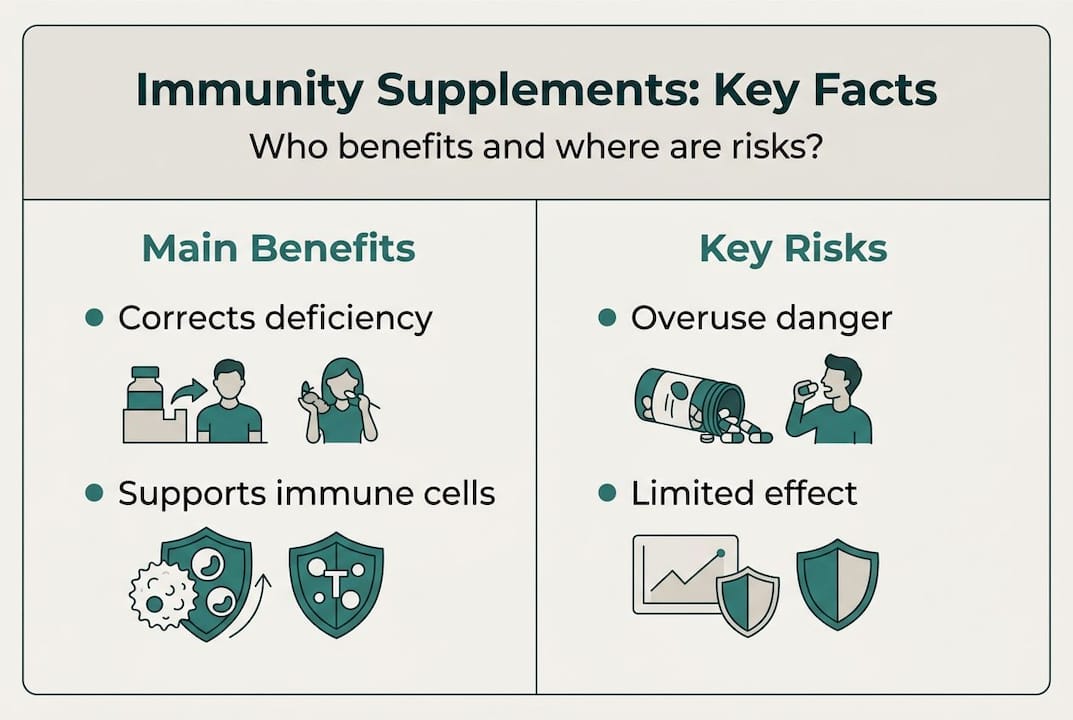
Data shows that supplements are insufficient for preventing or treating infections in non-deficient individuals, and current guidance consistently prioritises dietary foundations over supplementation for the general population. This applies even in the context of widely marketed immune boosters.
Vitamin C is a useful example. It supports immune function at a cellular level, but supplementation does not prevent infections in well-nourished people. It may reduce the duration of a cold by a modest amount, but it will not stop you from catching one.
Common pitfalls to avoid:
- Taking fat-soluble vitamins in excess: Vitamins A, D, E, and K accumulate in body tissue. Prolonged high-dose use can cause toxicity, particularly with vitamin A and D.
- Ignoring supplement-drug interactions: Vitamin E and fish oil can increase bleeding risk in people taking anticoagulants. Zinc can interfere with antibiotic absorption.
- Assuming more is better: Higher doses do not produce proportionally greater immune benefits once deficiency is corrected.
- Substituting supplements for medical care: Supplements support health but do not treat illness. Persistent symptoms require professional evaluation.
“The best immune support starts with a nutrient-rich diet, adequate sleep, regular physical activity, and stress management. Supplements fill specific gaps; they do not replace the foundations.”
For a full overview of how to use supplements safely, supplement safety tips covers the key risks and how to avoid them. More detailed context on specific nutrients is available via the immune function details resource from the National Institutes of Health.
Our perspective: Why most people misunderstand immunity and supplements
The supplement industry has done a remarkable job of conflating “supports immune function” with “boosts immunity.” These are not the same thing, and the distinction matters enormously.
Supporting immune function means providing the raw materials your body needs to maintain its normal defences. Boosting immunity, in the way it is typically marketed, implies pushing those defences above their natural set point. There is very little credible evidence that any supplement achieves the latter in a healthy, well-nourished adult.
What we observe consistently is that people who benefit most from supplementation are those who were already deficient. Correcting a deficiency restores function. It does not create a superior immune state.
The more productive question is not “which supplement should I take?” but rather “what does my body actually need?” That requires honest assessment, ideally with professional input, not a shopping list driven by marketing claims.
A holistic approach, combining a varied diet, movement, sleep, and targeted supplementation where genuinely needed, consistently outperforms any single-supplement strategy. Explore top nutritional products that align with this evidence-led philosophy.
Explore evidence-based immunity support with Vivetus®
Understanding the science is the first step. Putting it into practice requires access to reliable, evidence-backed products and resources.
At Vivetus®, the focus is on supplements that are grounded in research and suited to the specific needs of health-conscious adults and those navigating the changes that come with ageing. Whether you are looking to address a confirmed deficiency or build a more structured approach to long-term immune health, the product range and supporting guides are designed to help you make informed decisions. Free shipping on orders over €50 makes it straightforward to get started without unnecessary cost.
Frequently asked questions
Can supplements really boost immunity if my diet is already healthy?
For individuals with a balanced diet, supplements offer little benefit unless a specific deficiency such as vitamin D or B12 is present.
Which supplements are most important for ageing adults?
Ageing adults commonly benefit from vitamin D and zinc, particularly when deficiencies are identified. Vitamin D supports innate and adaptive immunity and is frequently insufficient in older populations, while zinc is vital for immune cell development and function.
Is it safe to take high-dose supplements for immunity?
High doses may be appropriate in cases of severe deficiency, but they carry real risks. Research shows that high-dose vitamin D plus NAC can reduce immunosenescence markers in deficient older adults, but always consult your doctor before increasing doses.
Do supplements prevent colds or infections?
Supplements do not prevent colds or general infections in healthy people. Vitamin C does not prevent infections in well-nourished individuals, though it may modestly reduce cold duration in some cases.