

Why invest in quality supplements for lasting vitality
Every day, thousands of health-conscious adults swallow supplements believing they’re investing in their wellbeing, yet many unknowingly consume products that deliver little to no benefit. The supplement industry’s explosive growth has created a marketplace flooded with both scientifically formulated products and ineffective alternatives laden with fillers. Understanding the profound difference between quality supplements and their lower-grade counterparts isn’t just about getting value for money, it’s about safeguarding your health and genuinely supporting your body’s vitality as you age. This article cuts through the confusion to reveal exactly why investing in quality supplements matters, how to identify truly effective products, and what long-term benefits you can expect when you choose wisely.
Table of Contents
- Key takeaways
- The science behind quality supplements and vitality
- Comparing quality supplements with lower-grade alternatives
- How to identify and choose quality supplements
- The long-term benefits of investing in quality supplements for healthy aging
- Explore high-quality supplements designed for vitality
- Why invest in quality supplements: frequently asked questions
Key Takeaways
| Point | Details |
|---|---|
| Three quality criteria | Quality supplements are defined by purity, potency and bioavailability to ensure effective nutrient delivery. |
| Independent testing | Independent laboratory testing verifies purity and potency before purchase. |
| Avoid fillers and contaminants | Select products free from unnecessary fillers and harmful contaminants. |
| Better health outcomes | Higher quality formulations are linked to improved vitality and healthier ageing. |
The science behind quality supplements and vitality
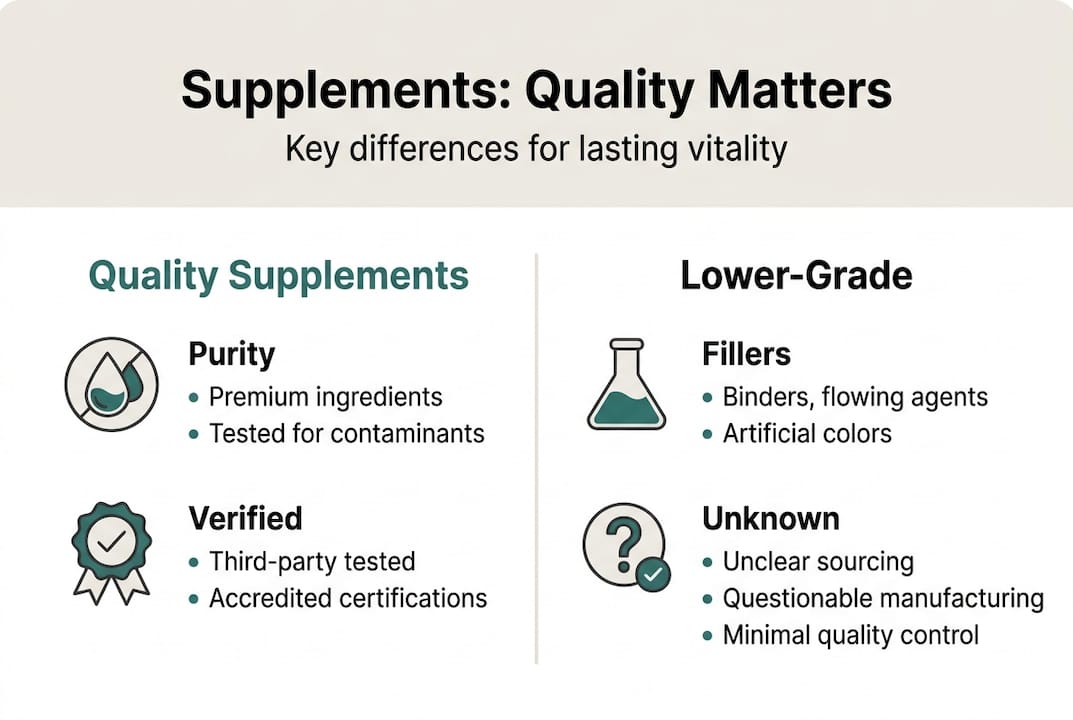
Quality supplements aren’t simply products with attractive packaging or clever marketing. They’re distinguished by three fundamental scientific criteria: purity, potency, and bioavailability. Purity refers to the absence of contaminants, heavy metals, and unnecessary fillers that dilute active ingredients. Potency measures whether the supplement contains the stated amount of active compounds in forms your body can recognise and process. Bioavailability determines how effectively your digestive system can absorb these nutrients and deliver them to cells that need them.
When any of these factors falls short, the supplement becomes substantially less effective or potentially risky. Impurities can introduce toxins that burden your liver and kidneys rather than supporting them. Poor formulations may use nutrient forms that pass through your system largely unabsorbed, rendering them biologically inert regardless of label claims. Premium supplements are linked to improved health outcomes due to superior purity and formulation, addressing these critical variables that cheaper alternatives often ignore.
Research consistently demonstrates that supplements meeting rigorous quality standards produce measurable improvements in vitality markers. Studies examining high-grade supplements show enhanced cellular energy production, improved antioxidant status, and better maintenance of physiological functions that typically decline with age. The difference isn’t marginal, quality formulations can produce effects three to five times more pronounced than their inferior counterparts.
When evaluating supplements for quality, look for these scientific indicators:
- Third-party testing certifications from independent laboratories verifying purity and potency
- Transparent disclosure of ingredient sources and manufacturing processes
- Bioavailable nutrient forms backed by absorption studies
- Appropriate dosing based on clinical research rather than arbitrary amounts
- Absence of artificial colors, unnecessary binders, and common allergens
Pro Tip: Seek supplements displaying USP, NSF International, or Informed Choice certifications on their labels. These third-party verifications confirm that independent laboratories have tested the product and verified it contains what the label claims without harmful contaminants.
Understanding how dietary supplements support vitality requires recognizing that your body operates as an intricate biochemical system. Quality supplements provide the precise molecular building blocks this system needs, whilst poor alternatives offer biological noise that your body must work to filter out.
Comparing quality supplements with lower-grade alternatives
The supplement market presents a bewildering spectrum of options at vastly different price points, creating understandable confusion about whether premium products justify their cost. A direct comparison reveals stark differences that extend far beyond pricing.
| Factor | Quality Supplements | Lower-Grade Alternatives |
|---|---|---|
| Purity | Rigorously tested, minimal fillers | Often contain binders, artificial colors, potential contaminants |
| Efficacy | Bioavailable forms, clinically studied doses | Poorly absorbed forms, arbitrary or insufficient doses |
| Safety | Third-party verified, transparent sourcing | Limited testing, undisclosed ingredient origins |
| Long-term value | Consistent benefits, reduced health risks | Unpredictable results, potential for wasted investment |
Investing in high-quality supplements ensures better wellness and reduces risks associated with contaminants or fillers that plague budget products. The long-term financial calculation actually favours quality supplements when you consider effectiveness. A supplement that costs half as much but delivers only 20% of the benefit represents poor value, requiring you to consume more products over time to achieve desired results.

One pervasive myth suggests that all supplements contain essentially identical ingredients, making expensive options mere marketing excess. This fundamentally misunderstands supplement manufacturing. The form of a nutrient dramatically affects absorption. Magnesium oxide, commonly used in cheap supplements, has roughly 4% bioavailability, whilst magnesium glycinate in quality formulations achieves 80% or higher. You’re not paying more for the same thing, you’re paying for a completely different biological outcome.
The risks of poor-quality supplements extend beyond wasted money:
- Heavy metal contamination from inadequately sourced raw materials
- Microbial contamination due to insufficient quality control during manufacturing
- Mislabelling that delivers incorrect doses, potentially causing adverse effects
- Inclusion of undeclared allergens that trigger immune responses
- Interaction risks from unlisted ingredients that affect medication metabolism
- Oxidised or degraded nutrients that have lost biological activity
These aren’t theoretical concerns. Regulatory testing repeatedly identifies supplements containing lead, arsenic, or mercury at concerning levels. Others have been found to contain virtually none of their stated active ingredients. The truth behind nutritional supplements is that quality control separates products that enhance health from those that merely extract money from well-intentioned consumers.
The cost-effectiveness equation shifts dramatically when you factor in health outcomes. Quality supplements may prevent the need for additional interventions, support better energy levels that improve productivity, and contribute to long-term wellness that reduces healthcare costs. Lower-grade alternatives offer none of these benefits whilst potentially introducing new problems your body must address.
How to identify and choose quality supplements
Navigating the supplement marketplace requires a systematic approach to separate genuinely beneficial products from cleverly marketed placebos. Follow this practical checklist when evaluating any supplement:
-
Examine the supplement facts panel for specific ingredient forms, not just generic names. Quality manufacturers specify “methylcobalamin” rather than simply “vitamin B12” because the form matters for absorption.
-
Verify third-party testing through certifications visible on the label or manufacturer’s website. Independent verification provides assurance that someone besides the seller has confirmed product quality.
-
Research the company’s transparency regarding ingredient sourcing and manufacturing locations. Reputable manufacturers willingly disclose where and how they produce supplements.
-
Check for published clinical studies supporting the specific formulation, not just individual ingredients. Many companies cite research on ingredients whilst using different forms or doses than those studied.
-
Assess the dose against established research. Effective supplements provide amounts shown beneficial in studies, not token quantities designed to allow label claims.
-
Investigate the company’s quality control processes, including testing frequency and contamination screening protocols.
Understanding third-party testing requires recognizing what different certifications actually verify. USP verification confirms that a supplement contains the ingredients listed at declared potency and will dissolve properly for absorption. NSF International certification tests for contaminants and verifies good manufacturing practices. Informed Choice specifically screens for banned substances, particularly relevant for athletes.
When verifying clinical studies backing a product, look beyond marketing claims to actual research. Quality supplement companies provide specific study citations you can review. Be skeptical of vague references to “clinical studies” without details. Genuine research appears in peer-reviewed journals with methodology you can examine.
Pro Tip: Before committing to any supplement regimen, consult a healthcare professional familiar with nutritional biochemistry. They can assess your individual needs, identify potential interactions with medications, and recommend dosing appropriate for your specific health status and goals.
Choosing supplements for healthy aging becomes significantly easier when you apply these systematic evaluation criteria. The investment of time in proper vetting pays dividends through better health outcomes and avoided risks.
Your body deserves ingredients that actually work. Settling for inferior supplements because they cost less is like buying a car without an engine because it’s cheaper, the initial savings evaporate when you realise it can’t perform its intended function.
The long-term benefits of investing in quality supplements for healthy aging
The true value of quality supplements emerges not in days or weeks but across months and years of consistent use. Long-term studies tracking adults who maintain quality supplement regimens reveal sustained improvements across multiple vitality markers that typically decline with age.
| Health Metric | Baseline (No Supplements) | After 6 Months (Quality Supplements) | After 12 Months |
|---|---|---|---|
| Energy Levels | Declining 2-3% annually | Improved 15-20% | Maintained or improved further |
| Cognitive Function | Gradual decline | Stabilised or slight improvement | Measurable improvement in processing speed |
| Physical Performance | Decreasing stamina | Enhanced endurance 10-15% | Sustained improvement |
| Recovery Time | Lengthening | Reduced by 20-25% | Maintained at improved level |
Consistent use of quality supplements supports physical fitness and vitality in healthy adults, with effects becoming more pronounced as cellular systems receive sustained nutritional support. This isn’t about reversing aging but about maintaining physiological function at levels closer to your younger baseline.
The compound benefits extend beyond measurable metrics to encompass overall quality of life. Adults maintaining quality supplement regimens report better sleep quality, more stable moods, improved stress resilience, and greater capacity for physical activity. These subjective improvements correlate with objective measures of cellular health, including reduced oxidative stress and better mitochondrial function.
Additional long-term benefits from quality supplement use include:
- Enhanced immune system function with faster response to pathogens and better immune regulation
- Powerful antioxidant effects that protect cellular structures from oxidative damage
- Improved metabolic health including better blood sugar regulation and lipid profiles
- Support for healthy inflammatory responses that prevent chronic low-grade inflammation
- Better maintenance of muscle mass and bone density as you age
- Cognitive protection that may reduce risk of age-related mental decline
Viewing supplements as isolated interventions misses their role within a holistic healthy lifestyle. Quality supplements work synergistically with proper nutrition, regular physical activity, adequate sleep, and stress management. They don’t replace these fundamentals but amplify their benefits by ensuring your body has the biochemical resources to optimise every system.
The recent NMN supplement research exemplifies how quality supplements can support cellular energy production in ways that diet alone struggles to achieve. As we age, certain metabolic pathways become less efficient, and targeted supplementation can provide the specific support these pathways need.
Investing in quality supplements represents investing in your future self. The choices you make today about supplement quality directly influence your vitality, independence, and quality of life in the decades ahead. This perspective transforms supplements from optional extras into essential components of proactive health management.
Explore high-quality supplements designed for vitality
Now that you understand the profound difference quality makes in supplement effectiveness and safety, the logical next step is finding products that meet these rigorous standards. Not all supplement providers prioritise the scientific formulation, rigorous testing, and transparency that truly matter for your health.

Vivetus supplements for vitality are specifically formulated with the purity, potency, and bioavailability that this article emphasises. Every product undergoes third-party testing to verify it contains exactly what the label states without contaminants or fillers. The scientific approach ensures you’re investing in supplements that deliver genuine benefits rather than marketing promises. Explore the range designed specifically for adults seeking to maintain vitality and support healthy ageing with confidence that you’re choosing quality that works.
Why invest in quality supplements: frequently asked questions
What defines a ‘quality supplement’?
A quality supplement meets three essential criteria: purity verified through third-party testing, potency that matches label claims, and bioavailability ensuring your body can actually absorb and use the nutrients. It contains ingredient forms backed by scientific research at doses shown effective in clinical studies, manufactured under rigorous quality control that prevents contamination.
Are expensive supplements always better?
Price alone doesn’t guarantee quality, but genuinely high-quality supplements cost more to produce due to superior ingredients, rigorous testing, and proper manufacturing. The key is evaluating what you’re paying for: third-party certifications, transparent sourcing, and bioavailable nutrient forms justify higher prices, whilst marketing hype doesn’t.
How can I tell if a supplement is scientifically backed?
Look for specific citations to peer-reviewed studies on the manufacturer’s website or product literature, not vague claims about research. Quality companies provide study details you can verify, including journal names, publication dates, and methodology. The research should examine the specific formulation and doses used in the product, not just individual ingredients in isolation.
Can quality supplements replace a healthy diet?
No supplement, regardless of quality, can replace the complex nutritional matrix provided by whole foods. Quality supplements are designed to complement a healthy diet by filling specific nutritional gaps, supporting increased needs during aging, or providing targeted support for particular physiological processes. They work synergistically with good nutrition rather than substituting for it.
How soon can I expect to see benefits from quality supplements?
Timelines vary depending on what you’re supplementing and your individual biochemistry. Some benefits like improved energy may emerge within weeks, whilst others like bone density support require months of consistent use. Quality supplements produce gradual, sustainable improvements rather than dramatic overnight changes, with effects becoming more pronounced over time as your body’s nutrient stores optimize.