

5 Checks to Verify NMN Quality in 60 Seconds for Dutch Buyers
Price, packaging, and marketing claims tell you nothing about what’s actually in the capsule. If a seller cannot produce a COA matching the batch number on your bottle, treat the product as unverified, whatever the label promises.
TL;DR:
- Verify that each batch-specific COA matches your product’s lot number and confirms a purity of 98% or higher using reliable testing methods like HPLC or LC–MS.
- Ensure the COA includes a full contaminant panel with detailed, named tests for heavy metals, microbes, and residual solvents, and seek finished-product testing rather than raw material reports.
- Trust laboratory methods such as HPLC, UPLC, LC–MS, and NMR, and avoid results from vague or in-house testing that lack accreditation or measurable uncertainty.
- Be cautious of low-priced products with vague labels, identical COAs across brands, or packaging showing signs of moisture or deterioration, which suggest poor quality or contamination.
- Store NMN in opaque, airtight containers with desiccants, prefer dry powder or capsule formats, and check that the production date and COA test date are recent to ensure potency.
Table of Contents
- Nmn kwaliteit herkennen: the 60-second buying checklist
- How to read a Certificate of Analysis for NMN
- Which lab methods and standards actually mean something
- Common red flags and deceptive practices to watch for
- Storage, shelf life, and why potency fades
- What independent testing actually found
- Publisher perspective: why we insist on the paper trail
- Where to find NMN with the paper trail already in place
- Sources
- FAQ
Nmn kwaliteit herkennen: the 60-second buying checklist
Recognising NMN quality doesn’t require a chemistry degree. It requires knowing which five things to check before you add anything to your basket, and refusing to buy when one of them is missing.
- A batch-specific COA is publicly available and matches your bottle. The lot number on the document must correspond exactly to the lot number printed on your packaging. If the seller only offers a generic “quality tested” PDF with no batch reference, that’s not proof of anything.
- The assay result sits at 98% or higher, measured on the finished product using HPLC or LC–MS rather than a vague in-house method.
- A full contaminant panel is listed, covering heavy metals, microbial counts, and residual solvents, each with a named test method rather than a single pass/fail line.
- The ingredient is named precisely as β-Nicotinamide mononucleotide, ideally with a CAS number, not folded into a fuzzy “vitamin B3 complex.”
- Price per milligram is realistic and a batch number appears on the packaging itself, not just on a website page that could apply to any batch.
Run through these five points before checkout and you’ll filter out most of the weak products on the market in under a minute. Vivetus’s own buying guide for NMN walks through this same checklist in more depth if you want a reference to come back to.
How to read a Certificate of Analysis for NMN
A COA is only useful if you know what you’re looking at, and the biggest mistake buyers make is accepting a raw-material COA as proof of what’s in the finished capsule. A raw-material COA describes the powder before it was formulated, capsuled, or blended with excipients. It says nothing about what survived that process. For any potency claim, insist on a finished-product COA instead.
Once you have the right document type, check these fields:
- Method name. Look for HPLC, LC–MS, or NMR listed against the identity and assay tests. These techniques can distinguish NMN from closely related B3 compounds and degradation products, which simpler methods cannot do reliably.
- Assay percentage on an anhydrous basis. This strips out water content so the number reflects actual NMN, not moisture weight.
- Related substances and total impurities, usually expressed as a percentage, showing what else is present besides the active ingredient.
- Lab identity and accreditation, ideally ISO/IEC 17025, plus a test date and issue date that sit close to the product’s production date.
- Detection and quantification limits (LOD/LOQ) for the impurity tests, confirming the lab could actually detect problems if they existed.
If any of these fields are missing, contact the lab directly using the details on the COA. A legitimate laboratory will confirm whether a given report number and batch genuinely belong to them.
Pro Tip: Save a PDF copy of every COA you’re shown before you buy, not after. Sellers sometimes update or remove documents once a batch sells out, and you’ll want your own record if you ever need to compare a new bottle against an older one.
Which lab methods and standards actually mean something
Not every “tested” claim carries the same weight, and the gap between a credible method and a decorative one is often the whole story.
- Trust HPLC, UPLC, LC–MS, and NMR. These are separation and identification techniques capable of isolating NMN from similar molecules and quantifying it precisely.
- Distrust vague UV/vis absorbance readings or unnamed “in-house tests.” These methods can confirm that something absorbs light at a certain wavelength, which is a poor stand-in for confirming molecular identity.
- ISO/IEC 17025 accreditation is a genuine credibility marker. It means the lab’s procedures have been assessed against an international competence standard, and accredited labs are contactable and will stand behind their own report numbers.
- Watch for impossible precision. A result reading “100.000% purity” with no LOD/LOQ statement is a red flag, not a reassurance. Real analytical chemistry carries measurement uncertainty; a lab that reports none is either careless or not doing the test at all.
Industry testing guides consistently point to finished-product testing built on these named methods as the baseline, rather than relying on a supplier’s raw-material paperwork alone, as Light Labs sets out in its supplement testing guide.
Common red flags and deceptive practices to watch for
Some warning signs are obvious once you know to look for them, and they tend to cluster together on the weakest products.
- A price that undercuts the category by a wide margin, paired with vague labelling such as “vitamin B3 complex” instead of the specific compound name.
- COAs that are identical across unrelated brands, or that omit method names and lab contact details entirely.
- No finished-product testing at all, only a supplier’s raw-material claim or a generic “lab tested” badge with nothing to verify.
- Packaging that feels damp, clumped, or discoloured, which can point to moisture exposure or prolonged storage before it reached you.
Copied or mismatched COAs are common enough that verification guides now recommend contacting the issuing lab directly to confirm a report number, rather than trusting the PDF at face value, a point echoed in independent coverage of counterfeit NMN documentation.
Storage, shelf life, and why potency fades
NMN is sensitive to both moisture and heat, and poor storage is one of the quietest ways a genuinely well-made product loses potency before it reaches your shelf. Favour products packaged in opaque, airtight containers with a desiccant sachet, and be wary of clear jars sitting in direct light on a shop shelf.
Liposomal or liquid NMN formats tend to degrade faster than dry powder or capsules, which makes a recent COA test date and clear storage instructions on the label more important, not less. Always check the expiry or retest date, and be suspicious if the COA’s test date is many months removed from the product’s stated production date. A long gap suggests the batch sat somewhere, under conditions you can’t verify, before testing happened at all.
What independent testing actually found
Peer-reviewed testing of commercial NMN supplements measured NMN content ranging from completely non-detectable up to 99.2% of total sample weight, with a striking number of products showing large deviations from their own label claims. That’s not a narrow miss here and there. Some products contained essentially none of the ingredient they were sold as.
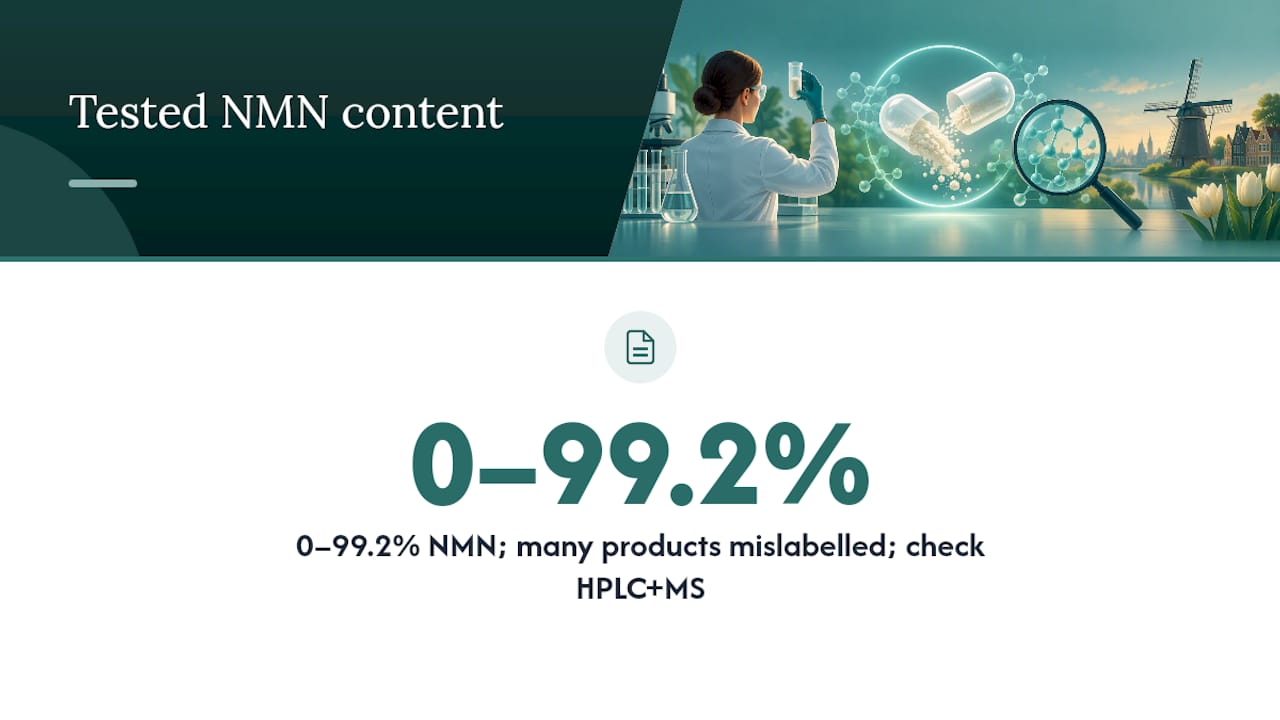
The consequence is straightforward: an under-dosed or degraded product cannot replicate the exposures used in clinical research, because NMN’s role as an NAD+ precursor depends on receiving a quantifiable, studied dose, not an approximate one. Contaminants and mislabelling compound the risk further. The testing standard behind these findings, HPLC combined with mass spectrometry, is exactly the verification method this checklist has pointed to throughout. It’s the same method you should be looking for on any COA in front of you.
Publisher perspective: why we insist on the paper trail
Jord’s view, built from working through this evidence, is simple: a supplement claim is only as good as the document behind it. Vivetus prioritises finished-product testing and keeps COAs available rather than treating them as an afterthought. My practical advice stays consistent regardless of brand: request the COA before you buy, not after, and keep your own copy. It’s the cheapest insurance available against paying for a product that isn’t what it claims to be.
— Jord
Where to find NMN with the paper trail already in place
Some sellers build their NMN range around the verification standard this article has walked through: batch-specific documentation you can actually check against your own bottle, rather than a marketing claim you have to take on trust.
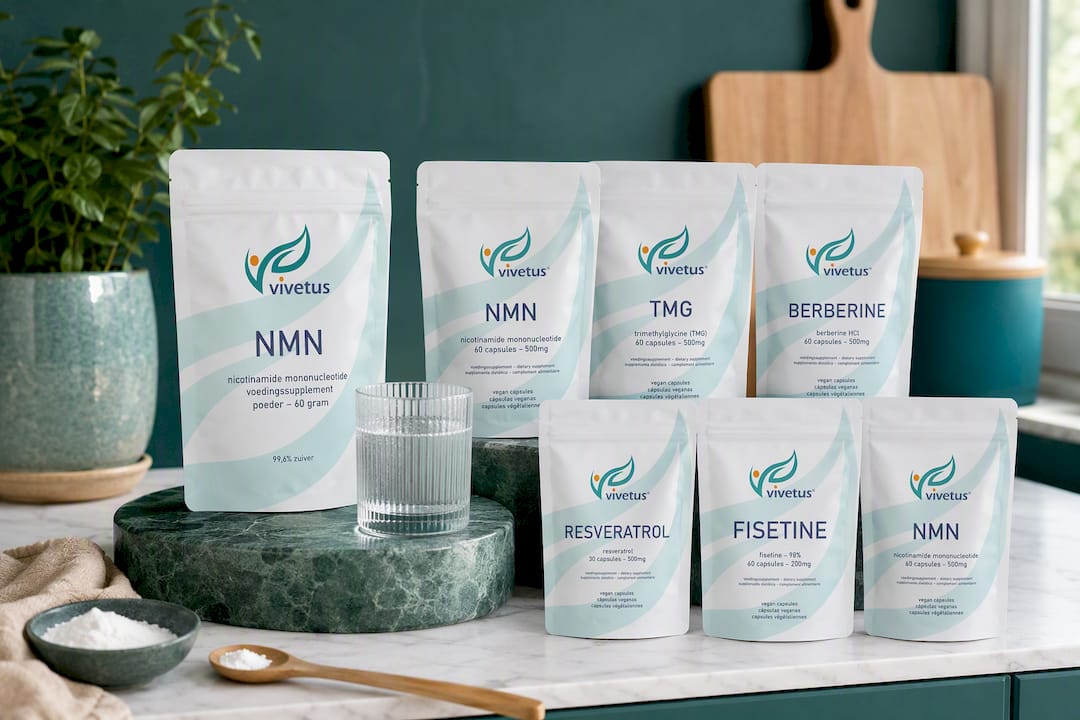
For readers who want to start with the ingredient itself, Vivetus® NMN poeder is formulated as a standalone powder for anyone building their own daily routine. If energy and cellular support are the priority, the 💪 EnergiePlus bundel pairs NMN with complementary ingredients in one order. For readers focused on cognitive clarity alongside healthy ageing, the Helder en Scherp bundel brings that combination together. You can browse the full NMN collection to compare formats, or check current pricing and batch information directly on the product page before you order.
Sources
- Testing the amount of nicotinamide mononucleotide and urolithin A as compared to the label claim - PMC
- NMN supplement quality: testing, labels, and compliance - Light Labs
This article is general information, not a substitute for advice from a qualified doctor. Consult a qualified healthcare professional about your own circumstances before acting on anything here.
FAQ
Welke NMN is het beste?
Vivetus applies this standard across its NMN range, which is a reasonable starting point if you want documentation you can actually check.
Is NMN verboden in Nederland?
This article focuses on quality verification rather than legal status, and rules can vary by country and change over time. If you have specific concerns about a product’s legal standing, check current guidance directly rather than relying on a supplement guide for that answer.
Wat is beter, NMN of NAD+?
NMN is a precursor that the body converts into NAD+, rather than a competing alternative to it. Oral NAD+ itself is harder for the body to absorb intact, which is why most research has focused on precursors like NMN to raise NAD+ levels indirectly.
Wat zijn de ervaringen van mensen met NMN?
Reported experiences vary widely partly because product quality varies widely. Independent testing found measured NMN content ranging from non-detectable to 99.2% of label claims across different commercial products, so a disappointing experience often traces back to a poorly verified product rather than the ingredient itself.
How much NMN should the label say per serving?
Serving sizes vary by brand and format, and the number on the label only matters if the finished-product COA confirms that assay independently. Check the label’s stated milligrams per capsule or scoop against the COA’s assay percentage rather than trusting either figure alone.