

Supplement labelling guide: 37% misread labels
TL;DR:
- Supplement labels are not pre-approved and rely on manufacturer self-compliance, so scrutiny is essential.
- The Supplement Facts panel provides critical, standardized information on doses, serving sizes, and ingredients.
- Buyers should verify doses against research, look for third-party seals, and avoid proprietary blends for safety.
Supplement labels carry more weight than most buyers realise. Research shows that 37 to 53% of consumers misinterpret structure/function claims as promises that a product can prevent or treat disease. For anyone focused on longevity and vitality, that misunderstanding can lead to wasted money, unrealistic expectations, and even health risks. This guide cuts through the confusion by explaining the core elements of supplement labelling: what each panel means, how claims are regulated, and the practical steps you can take to make genuinely informed purchases.
Table of Contents
- What is supplement labelling: core definitions and regulatory basics
- Demystifying the Supplement Facts panel: what to look for
- Claims on the label: structure/function, health, and disease claims
- Common pitfalls and actionable steps for longevity-focused buyers
- Why supplement labels demand more scrutiny than you think
- Discover tools for safer supplement choices
- Frequently asked questions
Key Takeaways
| Point | Details |
|---|---|
| Understand core label parts | The principal display and information panels provide key supplement facts, ingredients, and manufacturer details. |
| Scrutinise the Supplement Facts | Effective buying means focusing on nutrient amounts, %DV, and avoiding vague proprietary blends or fillers. |
| Interpret claims with caution | Structure/function claims are marketing statements, not proof of disease prevention—always check for DSHEA disclaimers. |
| Take actionable steps | Longevity buyers should check for accurate dosing, transparent ingredient lists, and rely on evidence-based resources. |
What is supplement labelling: core definitions and regulatory basics
Supplement labelling refers to all printed information on a dietary supplement package. Regulators divide packaging into two main areas. The principal display panel (PDP) is the front face of the product, showing the brand name, product identity, and net quantity. The information panel runs adjacent to the PDP and carries the Supplement Facts, ingredient list, allergen warnings, manufacturer details, and directions for use.
In the United States, supplement labelling is governed by the FDA under the Dietary Supplement Health and Education Act (DSHEA) and 21 CFR Part 101.36. These rules set out exactly what must appear, in what format, and where. The EU operates under its own framework, but core principles, including ingredient transparency and accurate quantity declarations, remain consistent across major markets.
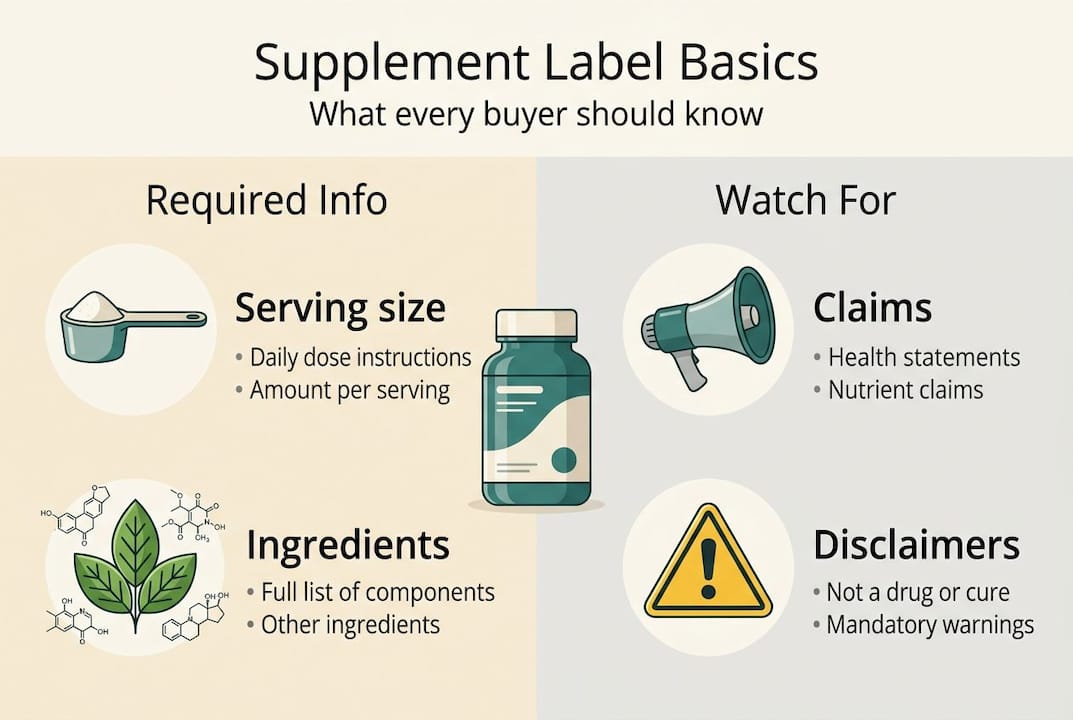
A key distinction worth knowing: supplements are not drugs. Drug labels must be pre-approved by regulators. Supplement labels are not pre-approved. Manufacturers bear the responsibility for compliance, which makes your ability to read labels correctly all the more important. You can explore supplement safety steps to build a stronger foundation before purchasing.
Supplement label vs. food label vs. medication label
| Feature | Supplement | Food | Medication |
|---|---|---|---|
| Regulatory body | FDA / DSHEA | FDA / FDCA | FDA / CDER |
| Pre-market approval | No | No | Yes |
| Nutrition panel type | Supplement Facts | Nutrition Facts | Drug Facts |
| Claims allowed | Structure/function | Nutrient content | Disease treatment |
| Manufacturer accountability | Self-compliance | Self-compliance | Pre-approval required |
Mandatory elements on a supplement label:
- Product name and form (capsule, tablet, powder)
- Net quantity of contents
- Supplement Facts panel
- Other ingredients list
- Name and address of manufacturer or distributor
- Directions for use
- Any required warnings or disclaimers
Understanding this structure gives you a reliable map of any supplement package you pick up.
Demystifying the Supplement Facts panel: what to look for
The Supplement Facts panel is the single most useful section on any supplement package. Think of it as the product’s identity card. Every element within it is legally mandated and follows a specific format, making it the most reliable source of information on the label.

Supplement Facts requirements include serving size, the number of servings per container, the amount per serving for each ingredient, and the percentage of Daily Value (%DV) where applicable. Ingredients without an established Daily Value receive a dagger symbol (†), with a footnote stating that no daily value has been set. This is common with herbal extracts and many specialised longevity compounds.
Reading the Supplement Facts panel step by step:
- Check the serving size first. All numbers on the panel relate to one serving, not the whole container. Many buyers overlook this and miscalculate their intake.
- Note the number of servings per container. This tells you how long one bottle will last and the true cost per dose.
- Review amounts per serving. Compare each nutrient or compound to clinically studied doses. A product listing 50 mg of a compound studied at 500 mg is unlikely to deliver the same effect.
- Check %DV values. These show how much of your daily requirement one serving provides. For key longevity nutrients like magnesium or vitamin D, aim for meaningful percentages.
- Scan the ingredient order. Ingredients are listed by weight, heaviest first. If a headline ingredient appears near the bottom, the dose may be negligible.
For reliable safety tips for healthy ageing, matching actual doses to evidence is a non-negotiable starting point.
Pro Tip: Watch out for proprietary blends. These list a combined weight for a group of ingredients without revealing individual amounts. They are entirely legal but make it impossible to verify whether any single ingredient reaches an effective dose. If a product hides behind a blend, treat it with caution. Our safe supplement use guide covers this in further detail.
| Panel element | What it tells you | Why it matters |
|---|---|---|
| Serving size | Quantity per dose | Prevents over or underdosing |
| %DV | Proportion of daily requirement | Contextualises nutrient intake |
| † (dagger) footnote | No established daily value | Common with botanicals and blends |
| Other ingredients | Fillers, binders, allergens | Identifies unwanted additives |
Claims on the label: structure/function, health, and disease claims
Supplement labels carry different types of claims, and knowing which is which protects you from misplaced trust.
Structure/function claims describe the role a nutrient or ingredient plays in normal body function. Examples include “supports heart health” or “helps maintain bone density.” These claims do not require FDA approval, but DSHEA requires a disclaimer stating: “This statement has not been evaluated by the Food and Drug Administration. This product is not intended to diagnose, treat, cure, or prevent any disease.”
Health claims are more restrictive. They describe a relationship between a nutrient and reduced risk of a disease and require FDA authorisation based on scientific evidence. You will rarely see these on supplement packaging.
Disease claims state that a product treats, cures, or prevents a disease. These are prohibited for supplements entirely. A product making disease claims is legally a drug and would require a completely different regulatory pathway.
“Structure/function claims are frequently misinterpreted as disease-prevention statements by consumers, despite the mandatory disclaimer present on labels.” PMC research
Scepticism is not optional here. Marketing language is engineered to be persuasive. Phrases like “clinically proven formula” or “doctor-recommended blend” carry no specific legal meaning in the supplement space. A thorough read of the supplement regulation report reveals just how wide the gap is between what claims imply and what regulations actually require.
- Structure/function claims: legal, no prior approval, disclaimer required
- Health claims: legal, FDA authorisation needed, rarely seen on supplements
- Disease claims: prohibited for supplements
- Implied claims: marketing language with no legal definition
For buyers focused on nutritional supplements for healthy ageing, understanding this distinction is foundational. It shapes how you interpret every word on a product’s packaging. Complement this with knowledge of supplement synergy for longevity to make more targeted choices.
Common pitfalls and actionable steps for longevity-focused buyers
Knowing what labels should say is only part of the picture. Labels are not always accurate. Research found that choline and iodine levels in prenatal vitamins were frequently either omitted from labels entirely or differed by more than 20% from the declared amount. That level of inaccuracy is significant for any buyer depending on precise dosing.
Practical steps to evaluate a supplement label:
- Verify the serving size and count the servings per container. Calculate the cost per dose, not just the retail price.
- Cross-reference doses against peer-reviewed research. If the Supplement Facts panel lists a dose far below what studies use, question the product’s effectiveness.
- Look for third-party verification marks. Seals from organisations such as USP, NSF International, or ConsumerLab indicate independent testing for accuracy and purity.
- Check the other ingredients list. Fillers such as silicon dioxide or magnesium stearate are generally harmless but can be a concern for those with sensitivities.
- Identify the manufacturer’s address. This allows you to verify the producer and cross-check with any publicly available compliance records.
- Avoid products relying solely on proprietary blends. Without individual ingredient amounts, you cannot confirm effective dosing.
Pro Tip: Search the manufacturer’s name alongside terms like “FDA warning letter” or “recall” before purchasing. This takes under two minutes and can reveal a history of labelling violations or quality issues that no amount of glossy packaging will disclose.
Reading supplement buyer reviews from verified purchasers adds another layer of real-world evidence beyond the label. For immune-supporting compounds in particular, consult an evidence-based guide for supplements to cross-check claims against the research.
Statistic to keep in mind: Over one-third of consumers believe structure/function claims indicate a product can prevent disease. That belief, unsupported by regulation, is precisely the gap that misleading labels exploit.
Why supplement labels demand more scrutiny than you think
Most guidance on supplement buying stops at “read the label carefully.” That advice is necessary but insufficient. The deeper issue is structural. The FDA does not pre-approve supplement labels. Manufacturers self-certify their compliance. Enforcement only follows after a problem surfaces, often after many consumers have already purchased and used a product.
This means that a label can be technically compliant with every regulation while still being practically misleading. Structure/function claims are often designed primarily as marketing tools. They are worded to evoke therapeutic benefit without crossing the legal line into disease claims. The result is a grey zone where consumer perception diverges significantly from regulatory intent.
The practical lesson here is straightforward. Brand reputation and label design are not evidence of quality. Independent third-party testing, clinically grounded doses, and transparent ingredient lists are the real markers of a trustworthy product. Scrutiny is not cynicism. It is the only rational response to a system built on self-compliance. Our safe supplement use guide provides structured criteria for evaluating products against these standards.
Discover tools for safer supplement choices
Navigating supplement labels becomes considerably easier with the right resources at hand. Vivetus® brings together evidence-based guides, practical safety checklists, and curated product information designed specifically for longevity-focused buyers.
Whether you are evaluating a new product or revisiting supplements already in your routine, the Vivetus supplement resources centre gives you structured, reliable information to act on. From understanding how to read a Supplement Facts panel to identifying red flags in manufacturer claims, you will find practical tools that match the rigour your health decisions deserve. Start with our supplement safety steps resource for a clear, actionable framework.
Frequently asked questions
What does ‘Supplement Facts’ mean on a label?
The Supplement Facts panel displays mandatory information including serving size, ingredients, and %DV, giving you a standardised basis for comparing products and verifying nutrient amounts.
How do I recognise misleading claims on supplement labels?
Look for the mandatory DSHEA disclaimer beneath any structure/function claim; its presence confirms the statement has not been FDA-evaluated and does not constitute a disease-prevention guarantee.
Are supplement labels audited by the FDA?
The FDA does not pre-approve supplement labels; manufacturers must self-comply, meaning regulatory action only occurs after a violation is identified, which places the burden of vigilance firmly on the consumer.
What should longevity-focused buyers check on supplement labels?
Prioritise products with clinically effective doses listed per ingredient, full ingredient transparency without proprietary blends, and independent third-party verification seals for purity and accuracy.